Most advisors get their first real number from somebody who wants to buy them. The number is usually honest as far as it goes, but a figure prepared by the party making the offer is a different instrument from a valuation.
If a bid is the only number you have ever seen, you have no way to know whether it sits near the top of your range or near the floor.
The deeper issue is that there is no single number to go find. You will get different numbers not just because of the financial circumstances of a buyer, but because of what they intend to do with the business.
A PE-backed consolidator is buying cash flow it intends to resell. More arbitrage, more money to acquire.
Your successor is buying continuity with clients they already know. Continuity, not arbitrage. Smaller exits.
The RIA across town may be buying a geography you happen to occupy. I often see this as the median offer when available. Stronger than internal succession, but not a PE-budget.
You have the same business, three distinct numbers. A reactive approach to understanding your business's value won't show you the spread. So the useful question is not what your practice is worth, as much as it is what your practice is worth to each kind of buyer.
The Industry Dynamics You Should Know
Two pricing methods are in play, and which one applies to you depends mostly on size.
Smaller books tend to be priced as a multiple of recurring revenue, which AdvisorLaw puts at around three to five times in the deals it sees at that end of the market.
Larger firms get priced on adjusted EBITDA instead, on the reasoning that once a practice has established infrastructure and staff, profitability tells you more about the business than revenue does.
The headline figure everyone quotes is Advisor Growth Strategies' record median of 11.6 times adjusted EBITDA, up from 11.0 the year before and roughly 8.0 in 2020.
That median is less useful than it looks, and the firm that produced it says so. Advisor Growth Strategies says a single $500 million firm can land anywhere between 9 and 15 times, depending on how it is positioned. That is a six-turn spread on an identical pile of assets. Any single number you hear quoted is one point inside a distribution that wide.
Size shows up in how steeply the band climbs and in how the band shifts depending on whether a standalone buyer or a platform is doing the buying. Pulling from DeVoe's 2026 RIA Deal Book and ECHELON's deal reports across 2024 through the second quarter of 2026:

Two things in that list matter more than the numbers.
Moving up a band is worth about two turns of EBITDA. Scale on its own, before anybody evaluates how well you run the place, is among the largest variables in what you get paid.
The second is the gap between those two columns at every level, which this piece argues is sitting in a published dataset. The same firm, on the same day, receives a different number depending on who is across the table.
So the honest answer to what your practice is worth starts as a wide field. Where you land within it depends partly on your business and partly on who is doing the asking.
Each Buyer Is Purchasing A Different Thing
The roll-up. A private equity-backed consolidator is buying cash flow it can aggregate and resell at a higher multiple than it paid. That is the model working exactly as designed, and once you understand it, you can predict most of how it will price you.
It wants recurring revenue, scale, clean normalized margins, and a business that still functions on the Monday after you stop showing up. On paper, it will often print the highest headline number at the table because it is underwriting the spread between your multiple and its own.
It tends to recover what it pays in headline through structure and autonomy. Cash at close for private equity backed buyers has run roughly 40 to 70 percent of consideration, down from the 80 to 90 percent that was normal historically, with earnouts of 20 to 40 percent and selling principals typically required to stay three to five years. Your investment process, your technology, and often your brand become candidates for consolidation, because consolidation is where the margin comes from.
The internal successor. Your next-generation advisor(s) buy continuity and a client base they already service, so they don't underwrite risk the way an outside buyer does. Very little about your business gets discounted here.
The ceiling comes down to their access to capital, which usually binds the whole transaction. DeVoe's data supports this from the other direction, finding that internal book sales tied to a retirement tend to fetch the lower end of the range, while the highest multiples go to deals with outside consolidators.
This is typically the lowest headline number of the four and the longest to pay out. It is also the only one where you keep more control of what happens to the culture, because you are the one handing it over. For advisors who are already financially independent, I hear this conversation a lot, regardless of whether they choose this option.
The strategic RIA. This is the widest variance of any buyer type, and the one advisors least often go looking for. A firm acquiring to fill a hole, whether that is a market, a niche, or a capability it has decided not to build, prices on strategic fit first and on your financials second.
There are a number of reasons these mid-market players become acquirers:
Geographic territory
Niche territory
Marketing momentum
Multi-generational team building
I actually see a decent number of these, but I'll also be the first to tell you that this process can get really messy when you're working with a new acquirer. Many businesses that became acquirers in the last several years don't have the personnel or processes to onboard you, even if they have the capital. This is where working with someone who has a pulse on these firms' internal workings is critical.
The platform-affiliated buyer. Here the thing being purchased is retention, and the economics follow from that. The number can be competitive, and in many cases it is.
This profile used to be theoretical. Several of the largest independent broker-dealers now buy practices directly, which makes it the newest of the four and the one advisors understand least. It gets its own section below.
The Platforms Are Buyers Now
For most of the history of the independent channel, your broker-dealer was not a potential buyer of your business. That has changed. Many of the large IBDs have entered the business of acquiring RIAs themselves, and the list now includes most of the names an advisor would seriously consider.
LPL documents its program in its own investor materials. Liquidity and Succession enables LPL to buy practices from advisors, positioned against what LPL describes as the historical options of selling to a larger aggregator or transacting with a local advisor at a below-market price.
The mechanics, as reported in the trade press:
LPL buys 100 percent of the practice from a principal generally expected to remain for about three years
Chosen successors run the firm while completing a 10-year successor advisor program
The selling advisor becomes an employee advisor and receives a reduced payout once LPL has acquired the firm
The successor runs the client-facing side at a payout typically below a standard LPL advisor's
Those last two lines rarely make it into the pitch, and they are where the cost sits.
The same pattern runs across the platform channel.
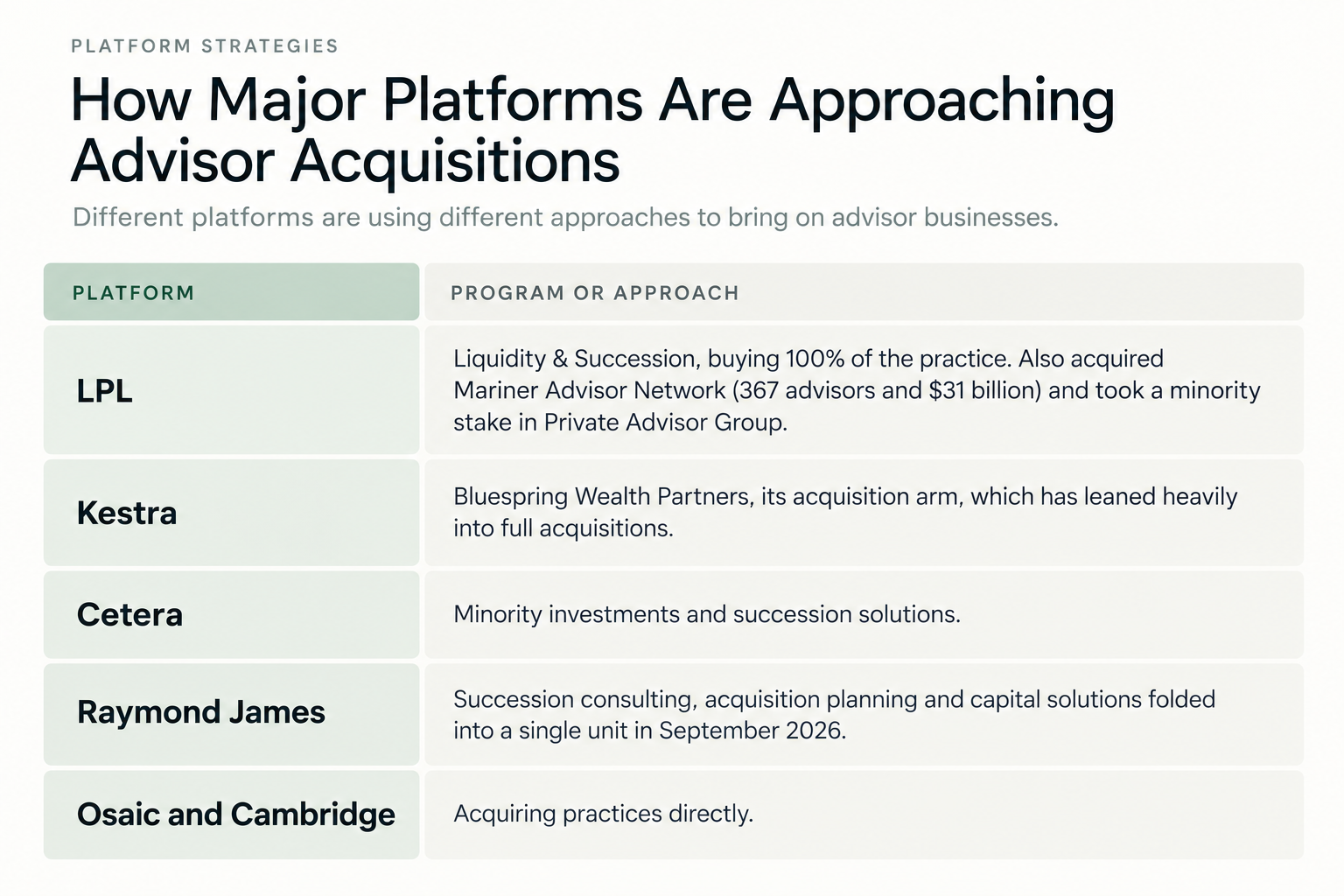
One industry consultant's warning in that same reporting is the sharpest framing available: IBDs could become walled gardens that stop letting advisors leave so easily.
These programs solve a real problem, and they deserve credit. A great many advisors have no internal successor with the capital to buy them out. A platform willing to write that check creates an exit where none existed, and advisors who would have wound a practice down now have a buyer.
The key is who sits at each table. The platform that sets your payout, holds your client data, and runs your technology is now also the party bidding on your business. Those roles sit in tension, and that tension remains even when the offer is fair.
Three questions are worth asking before you take a platform's number:
What would an outside buyer pay for this practice, and have I asked one?
What will my payout be after the sale, and for how long?
What does my successor earn under the program, measured against what they would earn independently?
A platform offer is one bid. Treat it the way you would treat any other bid.
Your Attributes Do Not Score The Same With Every Buyer
The underwriting factors are well documented. Recurring revenue above 90 percent, organic growth above 10 percent, and a fee-only revenue mix each tend to add between one and one and a half turns of EBITDA, while top-ten client concentration above 25 percent takes roughly three quarters of a turn back.
A median client age above 70 draws discounts of half a turn to a turn and a half, and buyers usually bridge that risk with retention earnouts running 24 to 36 months, leaving the headline figure alone.
Margin matters more than most advisors assume; DeVoe calculates that each additional point of EBITDA margin adds roughly 2.3 percent to value.
What gets missed is that those adjustments are buyer-specific.
Client concentration is a serious underwriting problem for a consolidator and close to a non-issue for a successor who has known the family for fifteen years.
Owner dependency is fatal to a buyer who wants you gone in three years and almost costless to one who wants you to stay.
A hybrid revenue mix is a discount to a fee-only platform and irrelevant to a buyer who already runs a hybrid.
The same line item on the same business is a discount in one conversation and an irrelevance in the next. Treat one buyer's read on your weaknesses as one buyer's read.
The Headline Number And The Money Are Different Numbers
Deal structure is where the real damage happens, and it has moved against sellers. Cash at close has fallen from roughly 80 percent of consideration in 2019 to between 55 and 65 percent, per ECHELON Partners and Advisor Growth Strategies benchmarks. In aggregator deals, the rest now splits roughly like this:
Rollover equity: 20 to 40 percent
Earnout: 10 to 25 percent
So the headline multiple has been climbing while the share you receive at close has been shrinking. Headline multiples hide more than they show. Compare these two offers:
12X with half the consideration sitting in a three-year retention earnout
9X, paid in cash
The first is the number that shows up in the trade press. Which one is better depends on your confidence in retention, your tax situation, and how much you want to still be working in year three.
Earnouts carry their own economics. Typical retention hurdles run 90 to 95 percent of clients retained through the transition window, measured 30 to 180 days after close. That puts the operational risk squarely on the seller.
So take any offer and model it against a 15 to 20 percent attrition scenario. If that changes your ranking, you have learned something the headline could not tell you.
How To Get A Number That Is Not Attached To A Bid
There are three ways to find your range, and they differ mostly in what they cost you.
The cheapest is to run it yourself. Take your normalized EBITDA, meaning your profit after you pay yourself a market salary for the work you do, and apply a multiple from your AUM band. Then adjust for recurring mix, growth, concentration, and client age. That gets you a working range in about an hour. The caveat is that it will not capture strategic fit, which is the largest swing factor of all, so treat the number as a floor. Also, just say... This is risky to make plans around when you DIY your valuation. I'm happy to connect you with someone who can help in this area.
The next step up is a paid independent valuation, which earns its keep when the number is about to matter. An appraisal you commissioned answers to you, and a free one answers to whoever paid for it. With DeVoe reporting in the second quarter of 2026 that none of the consolidators surveyed expected price gains, having your own objective number established before talks open is worth more in this market than it was in the one we had three years ago.
The last is to hear from more than one type of buyer before assuming any of them is the right answer, which is a different exercise from running an auction. The goal is to see the shape of the distribution, and one data point has no shape.
The Point Is Not The Highest Number
All of this serves one purpose: knowing which number you are looking at when someone puts one in front of you, and what accepting it would cost. Whether to sell, and to whom, stays a separate decision you can make later with better information.
The asymmetry is what bothers me. The firms on the other side of the table price practices every week and employ people who do nothing else. Most advisors do this once, at the end of a career, with whatever information they assembled on their own time.
That gap is the work I do. If you want to understand your range before anybody makes you an offer, I am here when you are ready.