A 90 percent payout is not 90 percent, and you probably already suspect that. Most advisors lack a full accounting of what comes out in between.
That missing accounting is why two people on the same stated grid can finish the year tens of thousands of dollars apart, and neither can explain how.
So it is worth walking the whole distance once. Gross revenue at the top, money in your account at the bottom, and every stop along the way.
The Grid Is One Line On A Much Longer Page
The three affiliation models each express compensation differently, and the differences go deeper than vocabulary.
Wirehouse advisors typically take home 35 to 45 cents of every revenue dollar, according to InvestmentNews reporting on 2026 compensation plans, with Kitces putting the low end nearer 35 percent and the largest producers and teams reaching 50 to 55 percent in some circumstances. That figure sits low for a reason. The firm is absorbing office, staff, technology, errors and omissions coverage, compliance, and benefits behind it.
Independent broker-dealers advertise 85 to 95 percent and hand the overhead to the advisor. Trade coverage of independent economics puts a nominal 90 percent payout in the low 70s once ticket charges, investment program fees, and the monthly compliance, technology, and E&O charges come out. That is before the advisor's own office and staffing costs enter the picture.
In the RIA model there is no payout in any meaningful sense. You receive your fees. You pay for everything.
The word payout gets used in all three of these contexts to mean three different things, which is most of why cross-model comparisons go wrong.
How Much Does a Financial Advisor Actually Take Home on $2.4 Million in Revenue?
Let's compare three different affiliation models using the same hypothetical advisor generating $2.4 million in annual gross revenue. (These are hypothetical based on common cases I see.)
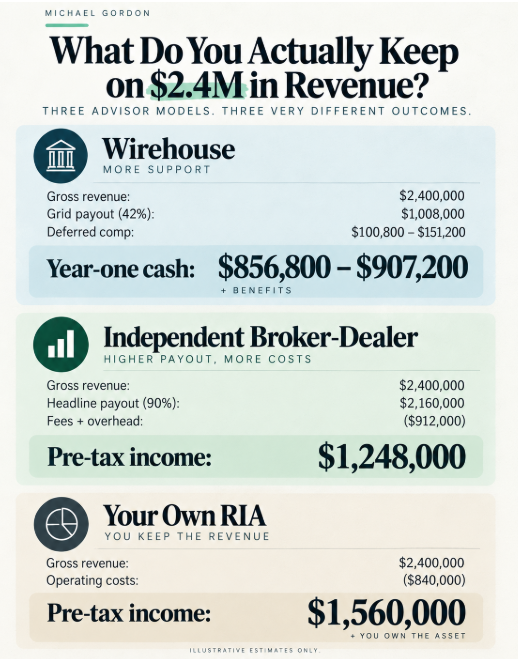
1. Wirehouse: Approximately $860K-$910K in First-Year Cash
At a 42% payout grid, the advisor earns $1,008,000. However, 10–15% of that compensation is likely deferred, leaving approximately $860K - $910K in first-year cash. The firm generally covers office space, staff, technology, compliance, and employee benefits. If you see that as a perk, it’s really a question of could you get that with more efficiency and choice in the independent channel? If you don’t see that as a perk, it’s time you went independent.
2. Independent Broker-Dealer: Approximately $1,248,000 in Pre-Tax Business Income
A 90% headline payout sounds impressive. On $2.4 million in revenue, that's $2,160,000.
After platform fees, ticket charges, technology, compliance, and other broker-dealer expenses, our illustrative effective payout falls to a ballpark of $1,728,000.
Subtract another $480,000 in business overhead, and you're left with approximately $1,248,000 before taxes, personal insurance, and retirement contributions.
3. Independent RIA: Approximately $1,560,000 in Pre-Tax Income
As an RIA owner, you retain all $2.4 million in revenue, but you're responsible for running the entire business. Let’s use a 35% operating expense ratio (fairly efficiency), approximately $1,560,000 remains before taxes. You also own an enterprise that may have significant value when you eventually sell or transition the business.
The Bottom Line
The highest advertised payout isn't necessarily the best financial arrangement.
A wirehouse provides infrastructure and benefits. An independent broker-dealer offers a higher payout with additional expenses. An independent RIA offers ownership and potentially greater long-term economics, alongside the responsibility of operating a business.
These are illustrative estimates, not actual advisor results. The wirehouse figure represents first-year cash compensation, while the independent figures represent pre-tax business income. Actual expenses, benefits, taxes, and compensation structures vary, so the figures aren't directly interchangeable.
The Transition Check Is A Loan (And Don’t Forget Taxes)
Recruiting money is the most misread number in this business, and the misreading is structural, built into how the money gets presented. Breakaway transition packages commonly range from 100 to 300 percent of trailing twelve-month production, with wirehouse-to-wirehouse competition pushing some packages nearer 400 percent.
What that money is, mechanically, is a forgivable promissory note. It is typically based on top-line revenue, taxed at ordinary income rates, and frequently runs nine to 13 years, often carrying both upfront and back-end components. A $1 million note forgiven over nine years generates roughly $111,000 of taxable W-2 income each year, stacked on top of whatever you are already earning.
So the check does not arrive as a check. It arrives as a decade of tax liability attached to a decade of commitment.
The detail I find most advisors have never been told is that the note is not technically a contract, which means you remain free to move during its life provided you can repay the unvested balance. Read that carefully. What holds you in place is the repayment obligation, and only to the extent that you lack the cash to satisfy it.
Which leads to the uncomfortable arithmetic. The largest check is frequently attached to the longest note at the platform that will cost you the most over the following decade. A 400 percent deal on a long note at a firm where your growth stalls can be worth less in total than a 150 percent deal somewhere your revenue compounds. The headline number is the easiest part of the offer to compare and the part that tells you the least.
Four Things To Request Before You Compare Anything
Two offers are not genuinely comparable until you have four documents in hand, and none of them arrive unless you ask:
The complete fee schedule, meaning every monthly and annual charge rather than the summary page
Ticket charges by product type, in writing
A clear line between what the platform fee includes and what gets billed separately
The full note terms, covering length, forgiveness schedule, any production hurdles, and exactly what is owed if you leave in year three
If a firm is slow to put any of those in writing, you have learned something useful at no cost. That is an efficient outcome for a request that takes one email to send.
Nobody Does This Math For You
The part worth acknowledging is that this comparison is hard, and an advisor who decides on headline rate is not being careless. The information required to do it properly sits in separate documents that nobody hands you at the same moment, uses the same vocabulary to mean different things across models, and comes from parties with no particular incentive to make the comparison easy.
That is the part I care about. Somebody should be sitting on your side of the table running the numbers, and the firms extending the offers are structurally unable to be that somebody.
Also worth saying plainly: running two offers side by side with every fee schedule in hand takes a few hours and most advisors never do it. I am happy to run yours, or to point you to someone who will.
When you want it done honestly, I am here.