Advisor transitions are generally driven by the hope that where you're going is better than where you are, whether you're going independent for the first time or moving between independent firms. That said, in thousands of conversations with advisors, fear of regret drives a lot of the decision-making.
As someone who has talked to those thousands of advisors, I can tell you a common trend in where I see regret most. Advisors who go independent almost never regret where they were as much as they regret where they landed. This is uniquely true among advisors leaving W-2 and wirehouse setups to go independent.
The survey work is consistent on this. In Schwab's research:
79% of advisors who went independent said they would make the same decision again
76% reported being happier
Advisor360's work on advisors who changed firms found 83% satisfied with the decision and 35% wishing they had moved earlier.
Those are not the numbers of a population that made a mistake by leaving. The risk lies in the choosing, and one finding in that same research shows where the choosing goes wrong.
The Regret Is Almost Always About Something That Was Verifiable In Advance
In the Advisor360 data, 86% of satisfied advisors said the technology at their new firm met expectations, while every single advisor who regretted the move said theirs did not. Technology was a key factor in the decision to switch for 79% of them, so they were buying the technology, and the ones who ended up unhappy bought a description of it.
That is worth reading twice, because it locates the regret. The regret traces back to believing a pitch that didn't match the platform. That is a diligence failure, and diligence failures are the kind you prevent with the right process. (Or help from me!)
The same pattern repeats well beyond technology.
The glowing “service” they pitched is inconsistent.
Support is slower than you were led to believe.
Autonomy was loosely promised, but you’re getting “no” more than you thought.
You won’t find this in a pitch, but you will find it in thorough due diligence. All of it is checkable in advance, once you know what to check and what a real answer sounds like.
Good Answers And Evasive Answers Do Not Sound The Same
Most advisors ask reasonable diligence questions and then accept a wider variety of answers, largely because the questions are unfamiliar territory and the answers sound plausible. The skill that matters here is recognizing what a real answer to each one sounds like next to a polished non-answer.
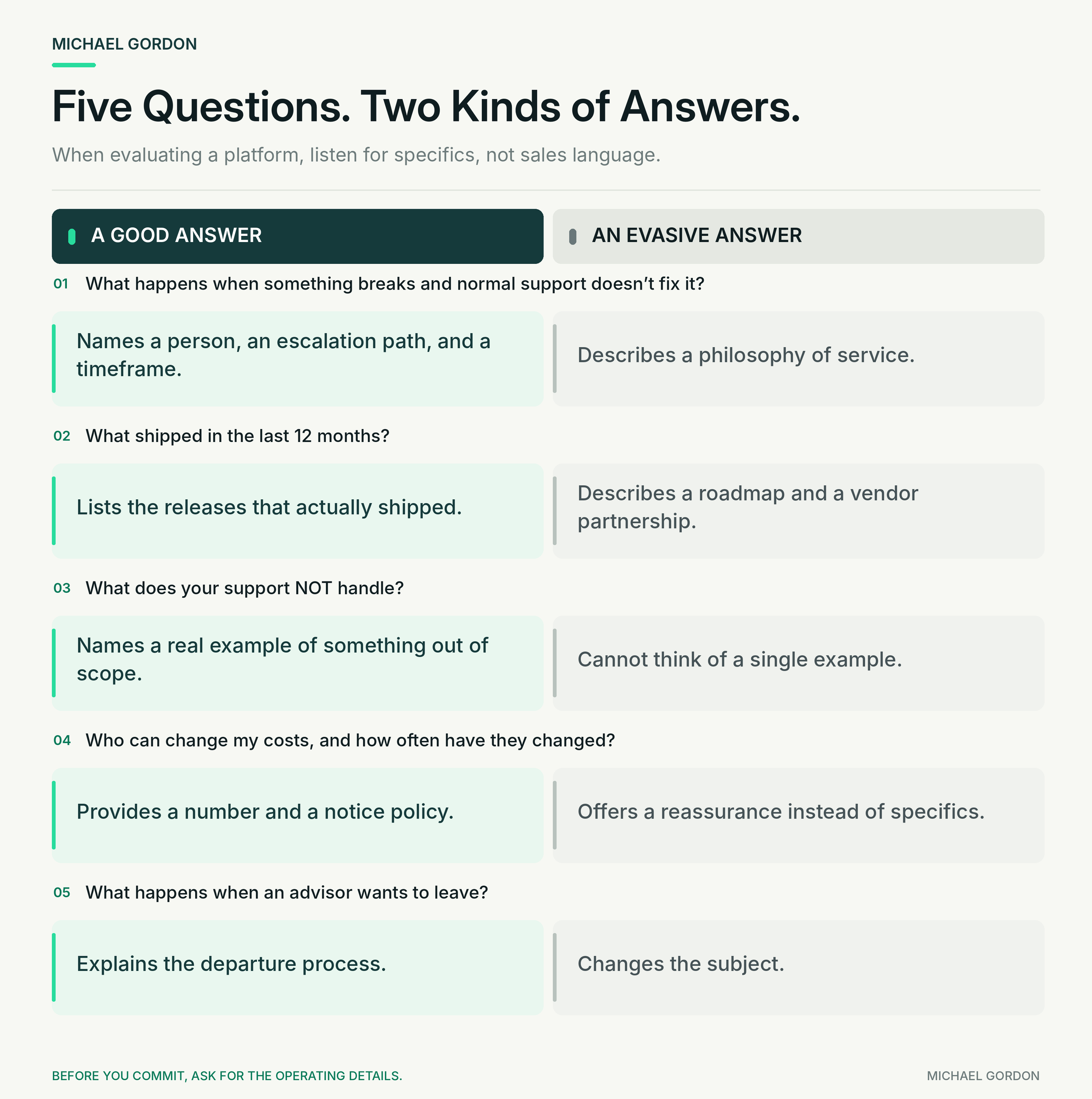
Given what the regret data says about technology, the second row is the highest-yield question on that list by some distance. Ask to see live examples, not just demos. Ask about innovation that has happened in specific terms. Roadmaps are not good enough.
(I have to say: many of my LPL advisors who've seen demos from Schwab, Fidelity, and Altruist are astonished by how much they don’t have at LPL, despite claimed $1B investments in technology.)
Call The Advisors Who Left
Every firm will put you in touch with three happy advisors, and those conversations are actually helpful. We’re not all pessimists. They carry limited information, though, because the party you're evaluating assembled the sample for you.
The references that carry real information are advisors who left that platform. They exist, they are findable through industry networks and public registration records, and they will tell you things that cannot be said inside a pitch process. When I work with advisors, I actively source these people not just for their unhappy qualifications, but for how similar they are to the advisor I'm working with. Three questions get the most out of those calls:
What surprised you?
What would you check if you were doing this again?
Was the thing that eventually drove you out visible before you joined?
That third one carries the most weight, because it tells you whether your own diligence has any chance of catching the same problem. There is a better question for the happy advisors too. Ask what has been harder than they expected. Nearly everyone has an answer, and the answers tend to cluster.
Diligence Is Cheap Until A Specific Point, And Then It Stops Being Cheap
Reading, asking, modeling, and talking to advisors who left costs you nothing but time and stays fully reversible at every stage. You can stop at any point, and nobody, including your current firm, is the wiser.
The cost begins when you sign the papers and fund a note, because from that moment forward, leaving means repaying the unvested balance. Client notification is the next threshold, and once you cross it, there is no longer such a thing as a quiet exit.
Everything before the first of those thresholds is free. The trouble is that most advisors treat the first exploratory conversation as the commitment, so they do only a fraction of the diligence they would bring to a business purchase of the same size, which this is.
Preparation Is Not Commitment
The advisors in those surveys who are glad they moved are not braver than you are. In most cases, they either checked more carefully or they got lucky, and only one of those two is something you can reproduce on purpose.
The structural problem is that nobody is paid to be on your side of this. The platforms have recruiters, the aggregators have deal teams, and you have whatever you managed to verify in the evenings.
That gap is the work I do, and it is why I would rather you do this diligence than be talked out of worrying about it. Happy to walk you through the questions above and tell you what I have heard back from advisors on the platform you are looking at.
When you want help checking before you choose, I am here when you are ready.